Parallel Alice without Eio
In my previous post I wrote about adding support for parallel builds to Alice using concurrency primitives from the Eio library. Eio doesn’t support spawning processes on Windows, and depending on Eio meant that I could no longer build Alice on Windows using Dune package management, which complicated development and CI workflows. It’s important to me that Windows users aren’t treated as second-class citizens, so I’ve dropped Eio as a dependency and implemented some parallel subprocess management logic directly in Alice.
As described in my previous post there are two places in Alice where it runs a
lot of external processes: computing inter-file dependencies with ocamldep and
compiling OCaml code with ocamlopt.
Computing dependencies is embarrassingly parallel. The ocamldep program needs
to be run on each source file in the project, and the order doesn’t matter.
We need to make sure the number of simultaneously running processes doesn’t
exceed the maximum number of jobs (the argument to -j), and the standard
output of each process needs to be collected and parsed so Alice can find out
inter-file dependencies. The strategy will be to start as many processes as is
permitted by the maximum number of jobs, and then whenever a process completes,
start a new process in its place.
To check if a process has completed, the standard library has a function:
val waitpid : wait_flag list -> int -> int * process_status
Passing WNOHANG in the list of wait_flags causes the function to return
immediately with a (non-existent) pid of 0 if the process is still running.
Alice needs to monitor the status of multiple concurrent processes so it can’t
block until any specific process completes. It spins in a loop, continuously
checking the status of all running processes, with a short pause in between each
iteration via Unix.sleepf so your computer doesn’t get too hot.
Actively polling the status of each running process in a loop feels a bit inefficient, and the standard library does provide an alternative way to wait until any child process completes:
  val wait : unit -> int * process_status
  (** Wait until one of the children processes die, and return its pid
     and termination status.

     @raise Invalid_argument on Windows. Use {!waitpid} instead. *)
But unfortunately it’s not available on Windows, so actively polling will have to do.
To parallelize computing dependencies I implemented the above strategy for scheduling processes, and refactored the logic around it to compute all dependencies as a single batch. This is less ergonomic than using Eio since I can no longer write straight-line code and mostly pretend it’s synchronous.
Next I parallelized compiling OCaml code. This was more complicated because invocations of the compiler are constrained by a partial order, with some commands needing to have completed before others can start. Alice computes a DAG representing the build plan which exactly captures these relationships between commands already, and this DAG can be used to schedule processes in a correct order.
The strategy will be similar to computing dependencies, except we need to be careful to only start processes when they’re ready. Each node in the DAG represents a command for which a process will be spawned. Initially just the leaves of the DAG (the nodes with no children) can be started. When a process completes, check each of its parents to see if any of them are now ready to start. Add all the ready parents to a “ready” queue, and start as many processes from this queue as are allowed by the user-specified maximum number of jobs.
The main difficulty was due to technical debt. My DAG implementation didn’t have a way to access tho parents of a node, and initially each node in the build plan represented a file to be built rather than a command. Nodes knew the command that would create their file, but since commands can generate multiple files, commands were effectively duplicated between multiple nodes (all the nodes whose files the command would create). When scheduling processes it’s much easier to think of nodes as commands, and not duplicate commands, so it was DAG-refactoring o’clock which meant updating the logic for generating build plans and dependency graphs which share the same underlying DAG representation despite being unrelated to the work I set out to do parallelizing Alice.
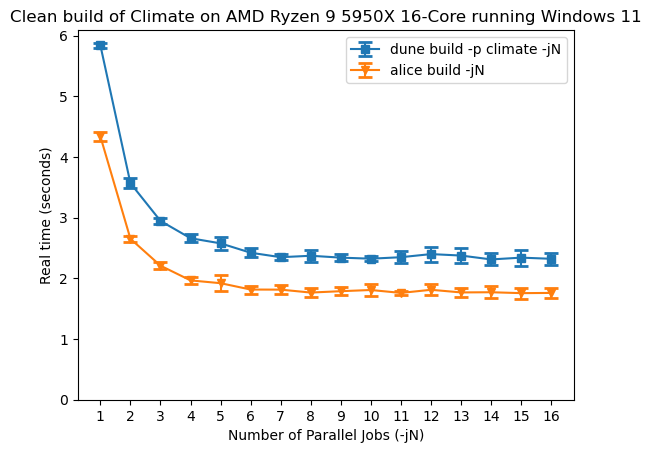
Now that parallel Alice works on Windows I can add an additional set of benchmarks to the comparison with Dune from my previous post.